
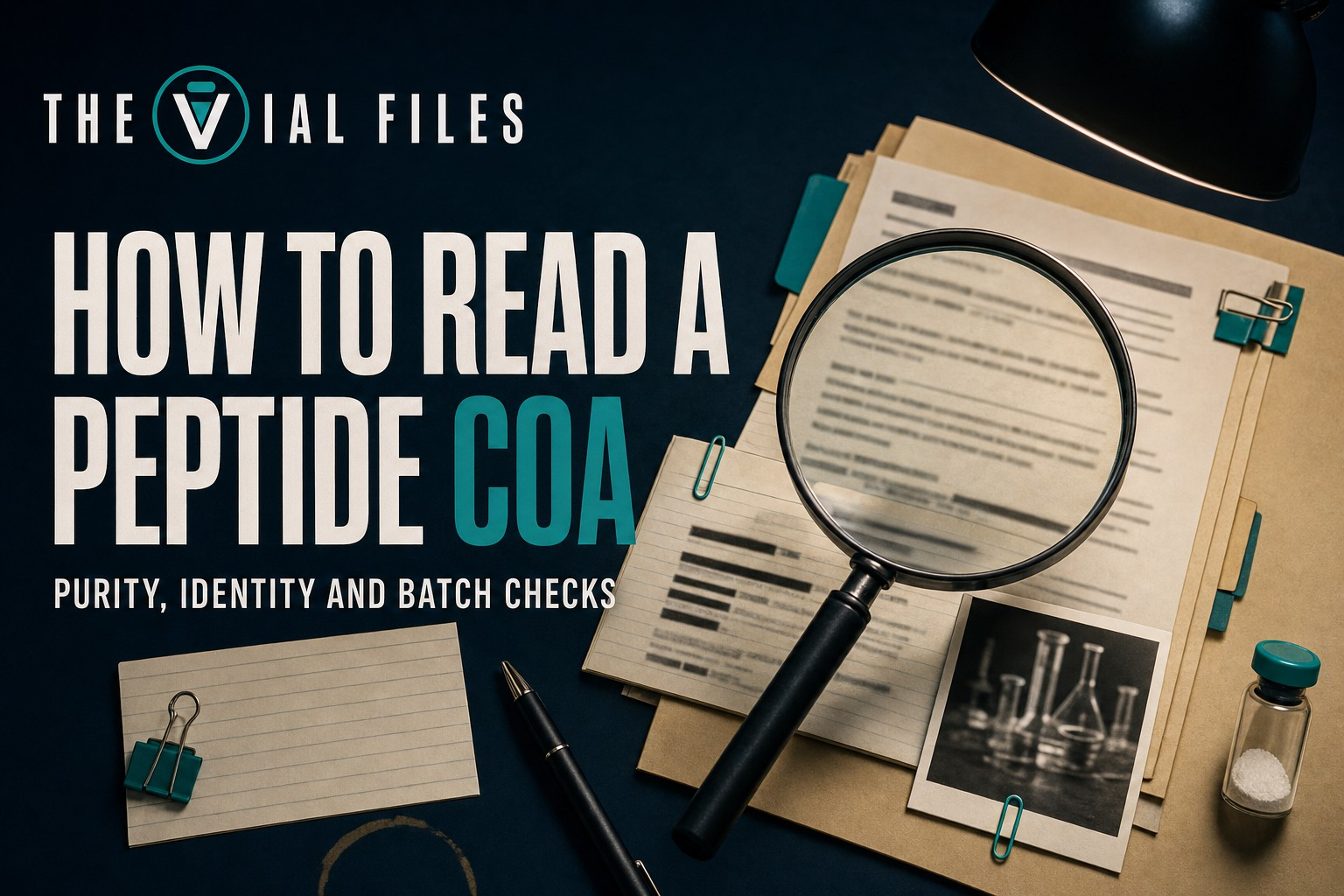
A certificate of analysis (COA) is the single most useful document a research peptide vendor can give you. It is also the easiest one to fake, recycle or misread. Here is what a good COA contains and how to check that it actually belongs to the vial in front of you.
The five things every COA should show
- Compound name and sequence or CAS number. It should match exactly what you ordered.
- Purity by HPLC. High-performance liquid chromatography separates the target peptide from impurities. Results are reported as a percentage, usually with the chromatogram attached.
- Identity by mass spectrometry (MS). Purity tells you how much of one thing is present; MS tells you what that thing is. Look for an observed mass that matches the theoretical molecular weight.
- Batch or lot number. This ties the test to a specific production run. It should match the label on your vial.
- Testing lab name and date. An independent, named laboratory and a recent test date.
Purity vs. peptide content
These are not the same number. Purity (for example 99.1%) describes what share of the peptide material is the target sequence. Net peptide content describes how much of the powder’s total weight is peptide at all, since lyophilized peptides also contain counter-ions (like acetate or TFA salts) and residual water. Net peptide content of 70 to 90% is normal, even for a very pure product. A COA that only reports purity is not hiding anything; one that confuses the two is a sign the vendor doesn’t understand its own paperwork.
Optional but valuable tests
- Endotoxin (LAL) testing measures bacterial endotoxin contamination.
- Sterility testing checks for microbial growth.
- Heavy metals and residual solvents are less common for research peptides but a strong signal of a serious vendor.
- Quantity verification confirms the vial actually contains the labeled milligrams.
Red flags
- The same COA is used for every batch, or the lot number doesn’t match your vial.
- No lab name, or a lab name you can’t find anywhere.
- Purity reported without a chromatogram, or a chromatogram that has clearly been cropped or edited.
- A test date that is years old for a product that sells out monthly.
- Mass spec missing entirely. Purity alone can’t confirm you have the right compound.
- The vendor refuses to share a COA before purchase.
How to verify a COA
Many independent labs let you verify a report by its unique ID or QR code on their own website. If the lab offers verification, use it. If the vendor’s COA can’t be verified and the lab doesn’t respond to inquiries, treat the document as unconfirmed.
On The Vial Files, vendors marked COAs Verified are ones whose certificates we have matched against the issuing lab’s records. Have a COA you want a second opinion on? Post it in the COA reviews forum.
The Vial Files is an independent review site. Products discussed are sold by third-party vendors for laboratory research use only and are not intended for human consumption. Nothing on this site is medical advice. Some links are affiliate links; we may earn a commission at no cost to you. Learn more.


Leave a Reply
You must be logged in to post a comment.